REGENTS APPROVE CONSTRUCTION OF SEA TURTLE HOSPITAL AT TEXAS A&M UNIVERSITY AT GALVESTON
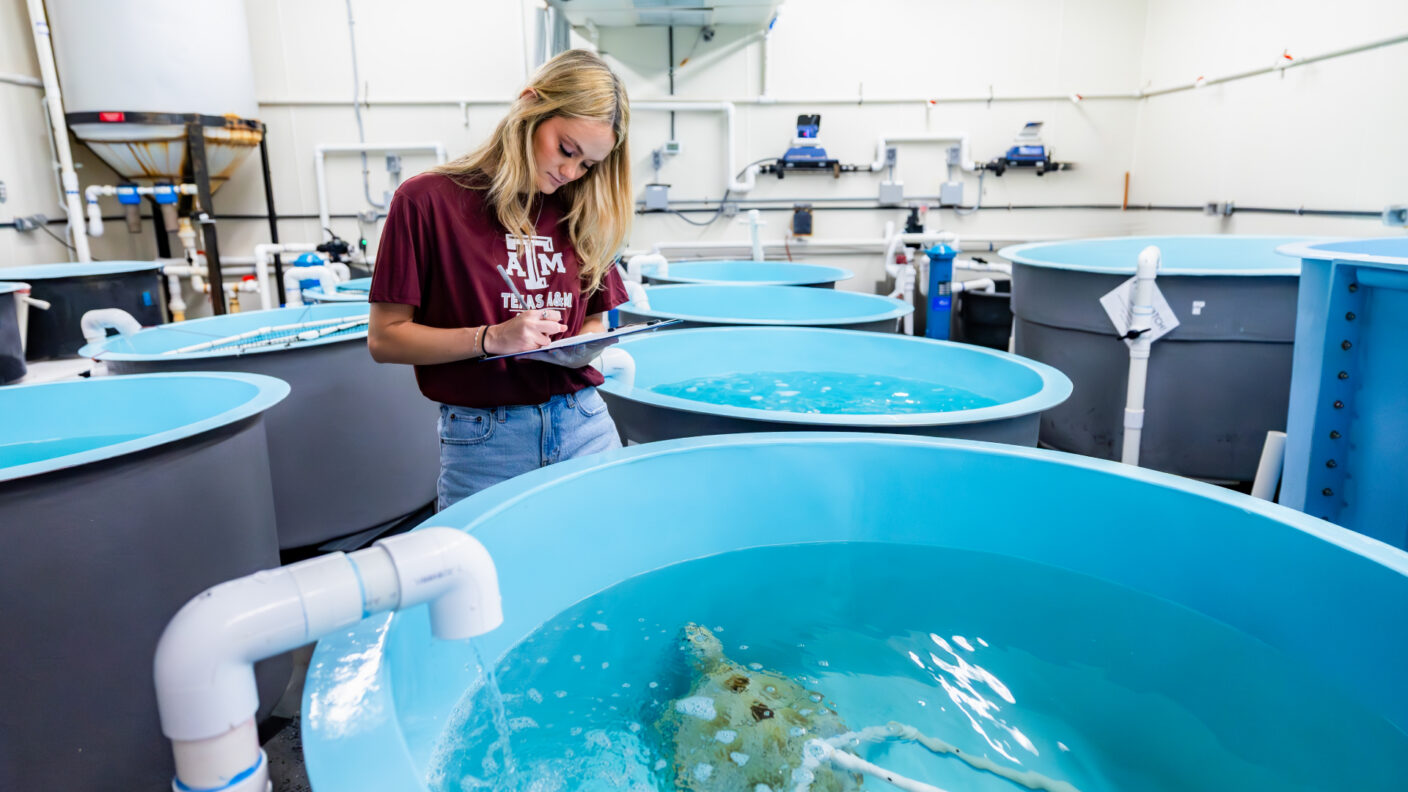
BRYAN-COLLEGE STATION, Texas – Construction will start next month on a new hospital for injured and stranded sea turtles at Texas A&M University at Galveston.
The Texas A&M University System Board of Regents on Thursday approved construction of the $29.8 million Cheryl Mellenthin Sea Turtle Rehabilitation Hospital and Educational Outreach Center, along with a larger scope and budget for the project. The hospital will treat up to 30 turtles at a time, taking over from the building where the campus has treated nearly 300 of them. Construction on the Pelican Island campus is scheduled to finish in October 2028.
The hospital will be home to Texas A&M at Galveston’s Gulf Center for Sea Turtle Research, the federally permitted lead for sea turtle rescue, recovery and rehabilitation on the upper and middle Texas coast. Christopher Marshall, a Regents Professor of marine biology, founded the center in 2019. It has since responded to more than 500 sea turtles.
The center now treats its patients in a 1,700-square-foot building at the campus Wetlands Center. The new hospital will give it room to grow and a way to isolate turtles infected with fibropapillomatosis, a contagious virus that causes tumors.
Board Chairman Robert Albritton credited the people who do the work.
“When a sea turtle washes up hurt on the upper Texas coast, Texas A&M at Galveston is the first call,” Albritton said. “The people there have done remarkable work for years. This board just gave them a hospital to match, and most of it is paid for with restoration grants and private gifts.”
The new building will cover about 13,900 square feet, with more than 85% of its usable space devoted to patient care. Plans include two patient wards, clinical procedures space, nutrition and laundry areas, and a room for monitoring the life-support systems that keep the tanks running.
Visitors will enter through a lounge where they can meet ambassador turtles, former patients that can’t be returned to the wild. A viewing gallery will let them watch staff care for patients behind the scenes. Texas A&M at Galveston has projected the center will draw more than 150,000 visitors a year.
All sea turtle species are listed as threatened, endangered or critically endangered, including the Kemp’s ridley, the official state sea turtle of Texas.
The board raised the project’s budget from $23 million to about $29.8 million to finish out spaces that had been lower on the original priority list, including both patient wards, the ambassador turtle tank and its life-support system, clinical procedures space, a workshop and offices. An added $6.7 million in grant funding and $67,610 in gifts cover the increase.
About $19.7 million of the total comes from restoration grants tied to the 2010 Deepwater Horizon oil spill and from Gulf of Mexico Energy Security Act funds awarded through the Texas General Land Office. Private gifts provide about $8.6 million and the Permanent University Fund $1.5 million. Cheryl Mellenthin, for whom regents named the center in August 2025, has given $8.55 million through the Mark A. Chapman Foundation.
Chancellor Glenn Hegar said the hospital will teach as much as it heals.
“This is a teaching hospital first,” Hegar said. “Students at our Galveston campus will learn marine biology with a patient in front of them, not just a textbook. And when families come through the door to meet the ambassador turtles, they’ll leave knowing a little more about the Gulf and why it’s worth protecting.”
About The Texas A&M University System
The Texas A&M University System is one of the largest and most impactful higher education systems in the country, with an annual budget of $9.1 billion. Its statewide network includes 12 universities, a comprehensive health science center, eight state agencies, Texas A&M-Fort Worth and the Texas A&M-RELLIS Campus. The A&M System also plays a direct role in U.S. national security as a member of the teams that manage and operate Los Alamos National Laboratory and the Pantex Plant for the U.S. Department of Energy’s National Nuclear Security Administration. The A&M System serves approximately 184,000 students and reaches millions more through research, service and outreach programs each year. With nearly $1.6 billion in annual research expenditures, the A&M System fuels innovation, supports communities and drives Texas’ economy forward.